Get into More Privacy Policy
This Privacy Policy governs the processing of your personal data by Get into More BV, a company registered in the Belgian Crossroads Bank for Enterprises under number 0640.972.535, with registered offices at C/O Silversquare, Louizalaan 231, 1050 Brussels, Belgium (hereinafter referred to as “Get into More”, “we”, “us” or “our”).
The privacy and security of your (hereinafter referred to as “you” or “your”) personal data are very important to us. The purpose of this Privacy Policy is to specify which categories of personal data we collect through our various activities.
Article 1 – General information
Our Privacy Policy categorizes the personal data we collect and explains how such data may be processed. We furthermore set out whether or not the personal data will be disclosed to third parties and the restrictions and safeguards to which we subject such transfers. To the extent desirable, the Privacy Policy also sets out the different measures we have implemented in order to safeguard the security and confidentiality of the personal data we may collect and process.
We may receive your personal data directly from you via our Website, our platform, subdomains and directories (collectively the “Website”), by email, voice calls, or through in-person interactions.
For the purpose of this Privacy Policy, we are to be considered the controller of your personal data. This means that the applicable data privacy legislation imposes certain obligations on us, including:
● the Belgian Act of 30 July 2018 on the protection of natural persons in relation to the processing of personal data,
● the Act of June 13th 2005 on the electronic communication,
● the General Data Protection Regulation (Regulation (EU) 2016/679 of 27 April
2016) (“GDPR”).
Should you have any questions regarding this Privacy Policy, or should you feel that your interests are not represented or are inadequately represented, please contact us at peter@getintomore.com.
You also have the right to lodge a complaint with the Belgian Data Protection Authority (see Article 12).
Article 2 – Personal data we collect and process
The personal data we may collect and process falls into several distinct categories:
Identification data: This category includes fundamental personal identifiers essential for communication and identification. Examples include your full name, physical address, email address, and telephone number. For business interactions, this may also extend to your company affiliation and your specific function or role within that organization. This data is typically collected when you interact with us, such as when you sign up for a service, make an inquiry, or engage in a business transaction.
Electronic identification data: In today's digital landscape, certain technical identifiers are crucial for the functionality and security of our online services. This category encompasses data such as your Internet Protocol (IP) address, which helps us understand your general location and protect against fraudulent activities. It also includes information collected through cookies, which are small data files stored on your device that help improve your browsing experience and remember your preferences. Furthermore, this category covers login data, including usernames and encrypted passwords, necessary for accessing our online platforms and services.
Professional information: When engaging with businesses or professionals, we may collect information relevant to your professional capacity. This includes your job position or title, the name of the company you represent, and invoicing details necessary for processing payments for services rendered or products purchased. This data is vital for maintaining accurate business records and facilitating commercial interactions.
Financial information: For transactions that involve monetary exchanges, we may collect specific financial details. This primarily includes bank account details, which are necessary for processing payments, whether for services you render to us or for services we provide to you. We handle all financial information with the utmost care and security.
In addition to the aforementioned structured categories, we may also collect any other information you voluntarily provide us. This encompasses a broad range of data that you choose to share with us outside of predefined forms or requests. For example, this could include details you provide in the body of emails, specific requests you make during phone conversations, or information shared during in-person meetings. This voluntary information helps us to better understand your needs, respond to your inquiries effectively, and provide more tailored services. We encourage you to only provide information that is relevant and necessary for your interaction with us.
Article 3 – Purposes of processing
Your personal data may be processed for the following purposes:
● To provide and improve our services.
● To manage the contractual relationship with you or your company.
● To handle administrative, financial, and invoicing purposes.
● To personalize communication and marketing.
● To comply with legal obligations.Your personal data may be processed for a
variety of essential purposes, all aimed at providing you with the best possible service, managing our relationship efficiently, and complying with legal requirements.
Specifically, your data may be used:
● To provide and improve our services. This encompasses all activities necessary to deliver the services you have requested, ensuring their proper functionality and enhancing their quality over time based on user feedback and technological advancements. This includes, but is not limited to, maintaining service performance, troubleshooting issues, and developing new features.
● To manage the contractual relationship with you or your company. This involves the full lifecycle of our agreement, from initial setup and onboarding to ongoing service delivery and eventual termination. It covers all administrative aspects related to the terms and conditions agreed upon, ensuring smooth operations and adherence to our commitments.
● To handle administrative, financial, and invoicing purposes. This category includes all necessary processes for managing financial transactions, such as processing payments, generating invoices, maintaining accurate financial records, and ensuring compliance with financial regulations. It also covers general administrative tasks required for the efficient operation of our business.
● To personalize communication and marketing. We may use your data to tailor our communications to your specific interests and preferences, providing you with relevant information about our services, updates, and special offers. This personalization aims to enhance your experience and ensure that the content you receive is meaningful and valuable to you. You will always have the option to opt out of marketing communications.
● To comply with legal obligations. As a responsible entity, we are subject to various laws and regulations that require us to process certain personal data. This includes, for example, obligations related to tax reporting, data protection, and other regulatory compliance. We process data only to the extent necessary to meet these legal requirements.
Article 4 – Legal grounds of processing
Processing is based on one of the following legal grounds:
● Your consent.
● Necessity for the performance of a contract.
● Compliance with a legal obligation.
● Legitimate interests pursued by us (such as business development).Our
processing of your personal data is always grounded in one of the following legal bases, ensuring transparency and compliance with applicable data protection regulations:
● Your Express Consent: We process your personal data when you have provided clear, affirmative consent for a specific purpose. This consent is freely given, informed, and unambiguous, and you have the right to withdraw it at any time, though this will not affect the lawfulness of processing carried out before withdrawal.
● Necessity for the Performance of a Contract: Processing your data is essential when it is required for the performance of a contract to which you are a party, or in order to take steps at your request prior to entering into a contract. This includes, for example, processing data necessary to fulfill an order, provide a service, or manage your account.
● Compliance with a Legal Obligation: We may process your personal data where it is necessary for compliance with a legal obligation to which we are subject. This could include, but is not limited to, obligations related to tax, financial reporting, or other regulatory requirements that mandate the processing of certain data.
● Legitimate Interests Pursued by Us or a Third Party: We process your personal data where it is necessary for the purposes of the legitimate interests pursued by us or by a third party, except where such interests are overridden by your interests or fundamental rights and freedoms which require protection of personal data. Our legitimate interests may include, but are not limited to, business development, improving our services, preventing fraud, ensuring network and information security, and direct marketing, always carried out with careful consideration of your rights and freedoms.
Article 5 – Disclosure to third parties
All processors are bound by strict confidentiality and data protection obligations.We are committed to safeguarding your privacy and will never sell your personal data to third parties. However, in order to operate our business effectively and comply with legal obligations, we may need to disclose your information to specific categories of recipients. These disclosures are always made under strict confidentiality and data protection agreements.
The parties with whom we may share your personal data include:
● Processors who support our business activities: These are third-party service providers who assist us with various operational functions. This can include, but is not limited to, IT service providers who manage our systems and data infrastructure, cloud storage providers, customer relationship management (CRM) platforms, and other technical or administrative support services essential for our operations. All such processors are carefully selected and are legally bound to uphold stringent confidentiality and data protection obligations, ensuring your data is handled with the same level of care as if we were handling it ourselves.
● Professional advisers: We may share your data with professional advisers such as lawyers, accountants, and auditors. This is typically done to obtain legal advice, manage our financial records, conduct audits, or ensure our compliance with relevant laws and regulations. These professionals are subject to their own strict ethical and legal duties of confidentiality.
● Competent authorities when legally required: In certain circumstances, we may be legally obligated to disclose your personal data to government bodies, regulatory authorities, or law enforcement agencies. This could be in response to a court order, subpoena, or other legal process, or to comply with applicable laws and regulations. We will always assess the legality of such requests and only disclose the minimum amount of information necessary to fulfill our legal obligations.
It is important to reiterate that all processors and third parties with whom we share your data are bound by strict contractual confidentiality and data protection obligations. This ensures that your personal data remains protected and is only used for the specific purposes for which it was disclosed, in accordance with applicable data protection laws. We continuously review our data sharing practices to ensure the highest standards of privacy and security are maintained.
Article 6 – International transfers
When transferring your personal data outside the European Economic Area (EEA), we are committed to ensuring robust protection and adherence to the highest data privacy standards. To achieve this, we implement appropriate safeguards as mandated by relevant data protection regulations, including:
● Adequacy Decisions by the European Commission: This involves transferring data to countries, territories, or specific sectors within a country that the European Commission has officially recognized as providing an adequate level of data protection. Such a decision means that the legal framework of the third country or international organization is deemed to provide a level of protection for personal data essentially equivalent to that guaranteed within the EEA.
● Standard Contractual Clauses (SCCs) Approved by the European Commission: In the absence of an adequacy decision, we utilize SCCs. These are pre-approved model data protection clauses that ensure appropriate safeguards are in place when personal data is transferred to a third country. They are legally binding commitments between the data exporter and the data importer, obligating them to protect the data according to EU data protection standards. These clauses are designed to ensure that personal data continues to benefit from the same high level of protection even when processed outside the EEA.
Article 7 – Retention period
We retain your personal data no longer than necessary to achieve the purposes described in this Privacy Policy, unless longer retention is required by law.We only retain your personal data for as long as is necessary to fulfill the purposes for which it was collected, as outlined in this Privacy Policy. This means that once the purpose for which your data was gathered has been achieved (e.g., providing a service, fulfilling a request, or managing your account), we will securely delete or anonymize it, unless a longer retention period is mandated by law.
Legal requirements may include, but are not limited to, obligations to retain data for tax purposes, regulatory compliance, or to comply with court orders. In such cases, we will adhere to the minimum retention periods prescribed by the relevant laws and regulations. We are committed to transparency and will ensure that our data retention practices are in full compliance with applicable data protection laws.
Article 8 – Security measures
We take appropriate technical and organizational measures to safeguard your personal data against unauthorized access, loss, misuse or alteration. This includes secure servers, restricted access, encryption and regular security reviews.
Article 9 – Your rights
Under the GDPR, you have the following rights:
● Right of access to your personal data.
● Right to rectification of incorrect or incomplete data.
● Right to erasure (“right to be forgotten”).
● Right to restriction of processing.
● Right to data portability.
● Right to object to processing based on legitimate interests or direct marketing.
● Right to withdraw your consent at any time.Under the General Data Protection
Regulation (GDPR), individuals are granted a comprehensive set of rights designed to provide them with greater control over their personal data. These rights empower data subjects to understand, access, correct, and even demand the deletion or restriction of processing of their personal information.
Specifically, these rights include:
● Right of access to your personal data: Data subjects have the right to obtain confirmation as to whether or not personal data concerning them is being processed, and, where that is the case, access to the personal data and certain information regarding the processing. This includes details such as the purposes of the processing, the categories of personal data concerned, the recipients or categories of recipient to whom the personal data have been or will be disclosed, and the envisaged period for which the personal data will be stored.
● Right to rectification of incorrect or incomplete data: If personal data held about an individual is inaccurate or incomplete, they have the right to have it corrected without undue delay. This ensures that personal information used by organizations is accurate and up-to-date.
● Right to erasure (“right to be forgotten”): In certain circumstances, individuals have the right to request the deletion of their personal data. This right applies, for example, when the data is no longer necessary for the purposes for which it was collected or processed, or when the individual withdraws consent and there is no other legal ground for processing.
● Right to restriction of processing: Under specific conditions, individuals can request that the processing of their personal data be restricted. This means that
while the data may still be stored, it can only be processed for limited purposes, such as with the individual's consent or for the establishment, exercise, or defense of legal claims. This right can be invoked when the accuracy of the data is contested, the processing is unlawful, or the organization no longer needs the data but the individual requires it for legal reasons.
● Right to data portability: This right allows individuals to receive their personal data, which they have provided to a controller, in a structured, commonly used, and machine-readable format. They also have the right to transmit that data to another controller without hindrance from the original controller, where the processing is based on consent or a contract and is carried out by automated means. This promotes data interoperability and allows individuals to easily transfer their data between service providers.
● Right to object to processing based on legitimate interests or direct marketing: Individuals have the right to object to the processing of their personal data where the processing is based on legitimate interests pursued by the controller or a third party, unless the controller demonstrates compelling legitimate grounds for the processing which override the interests, rights, and freedoms of the data subject, or for the establishment, exercise, or defense of legal claims. Furthermore, individuals have an absolute right to object to the processing of their personal data for direct marketing purposes, including profiling to the extent that it is related to such direct marketing.
● Right to withdraw your consent at any time: Where the processing of personal data is based on consent, individuals have the right to withdraw that consent at any time. The withdrawal of consent does not affect the lawfulness of processing based on consent before its withdrawal. Organizations must make it as easy to withdraw consent as it is to give it.
Article 10 – Exercising your rights
To exercise your rights, please contact us at peter@getintomore.com. We may ask you to provide proof of identity. We will respond as soon as possible, and in any case within one month.To exercise any of your rights regarding your personal data, or if you have any questions or concerns about our privacy practices, please do not hesitate to contact us. You can reach our dedicated privacy team by sending an email to peter@getintomore.com.
For your protection, and to ensure the security of your personal information, we may ask you to provide proof of identity before fulfilling your request. This measure helps us verify that you are indeed the individual requesting access to or changes to your data, thereby preventing unauthorized access or modifications.
We are committed to responding to all legitimate requests promptly and efficiently. You can expect to receive a response from us as soon as possible, and in any case, within one month of receiving your inquiry. We appreciate your patience as we process your request and ensure its accuracy.
Article 11 – Automated decision-making Automated Decision-Making and Profiling
We are committed to fair and transparent data practices. Therefore, we want to assure you that we do not engage in automated decision-making processes, including profiling, that could have significant legal or similar effects on you.
This means that any decisions concerning your rights, access to services, or other significant outcomes are not made solely by automated systems without human intervention. We believe in upholding individual rights and ensuring that algorithmic processes do not lead to discriminatory or unfair results.
Our approach to data processing prioritizes human oversight and accountability. While we may utilize data analytics to improve our services or understand trends, these analyses are used to inform decisions, not to replace human judgment. We do not use automated systems to create profiles of individuals that could then be used to make decisions with legal or similarly significant consequences, such as determining eligibility for services, creditworthiness, or employment opportunities, without appropriate human review.
Should there be any instance where automated processes contribute to a decision that affects you, we ensure that there is a clear process for human review and the opportunity for you to express your point of view and contest the decision.
Our aim is to maintain a balance between leveraging technology for efficiency and safeguarding individual liberties and fairness.
Article 12 – Complaints
If you are not satisfied with our response, you have the right to lodge a complaint with the Belgian Data Protection Authority (GBA). This independent authority is responsible for supervising compliance with data protection legislation in Belgium. The GBA can investigate complaints, issue guidance, and, where necessary, impose sanctions.
We encourage you to first address your concerns directly with us, as we are committed to resolving them promptly and effectively. If, however, your concerns remain unresolved, you may escalate the matter to the GBA using the following contact details:
Gegevensbeschermingsautoriteit (GBA)
Drukpersstraat 35 1000 Brussels Belgium
● Telephone: +32 (0)2 274 48 00
● Email: contact@apd-gba.be
● Website: www.gegevensbeschermingsautoriteit.be
On the GBA’s website, you can find more information about their role, guidance on data protection rights, and the procedure for filing a complaint.
Cookies
Our Website utilizes cookies to enhance the user experience and analyze website traffic. Cookies are small text files that are downloaded and stored on your device (computer, tablet, or mobile phone) when you visit a website. They serve various purposes, primarily to make your interaction with websites more efficient and personalized.Types of Cookies We Use:
● Essential cookies: These cookies are strictly necessary for the proper functioning of our website. Without them, certain core features, such as navigating between pages, accessing secure areas, or remembering items in a shopping cart, would not be possible. They are usually set in response to actions made by you, such as setting your privacy preferences, logging in, or filling out forms.
● Analytical cookies: Also known as performance cookies, these cookies help us understand how visitors interact with our website by collecting and reporting information anonymously. This data allows us to monitor website performance, identify popular pages, track the number of visitors, and see how users move around the site. The insights gained from analytical cookies enable us to improve our website's design, content, and overall user experience.
● Functional cookies: These cookies allow our website to remember choices you make (such as your username, language, or region) and provide enhanced, more personal features. For example, they can be used to remember changes you have made to text size, fonts, and other customizable parts of web pages. They can also provide services you have asked for, such as watching a video or commenting on a blog. The information these cookies collect may be anonymized, and they cannot track your browsing activity on other websites.
Managing Your Cookie Preferences:
You have the ability to manage or disable cookies at any time through your web browser settings. Most web browsers allow you to:
● View the cookies stored on your device and delete them individually.
● Block third-party cookies.
● Block cookies from specific sites.
● Block all cookies from being stored on your device.
● Delete all cookies when you close your browser.
Please note that disabling certain types of cookies, particularly essential cookies, may impact the functionality and features of our website. For more detailed instructions on how to manage cookies, please refer to the "Help" section of your specific browser.
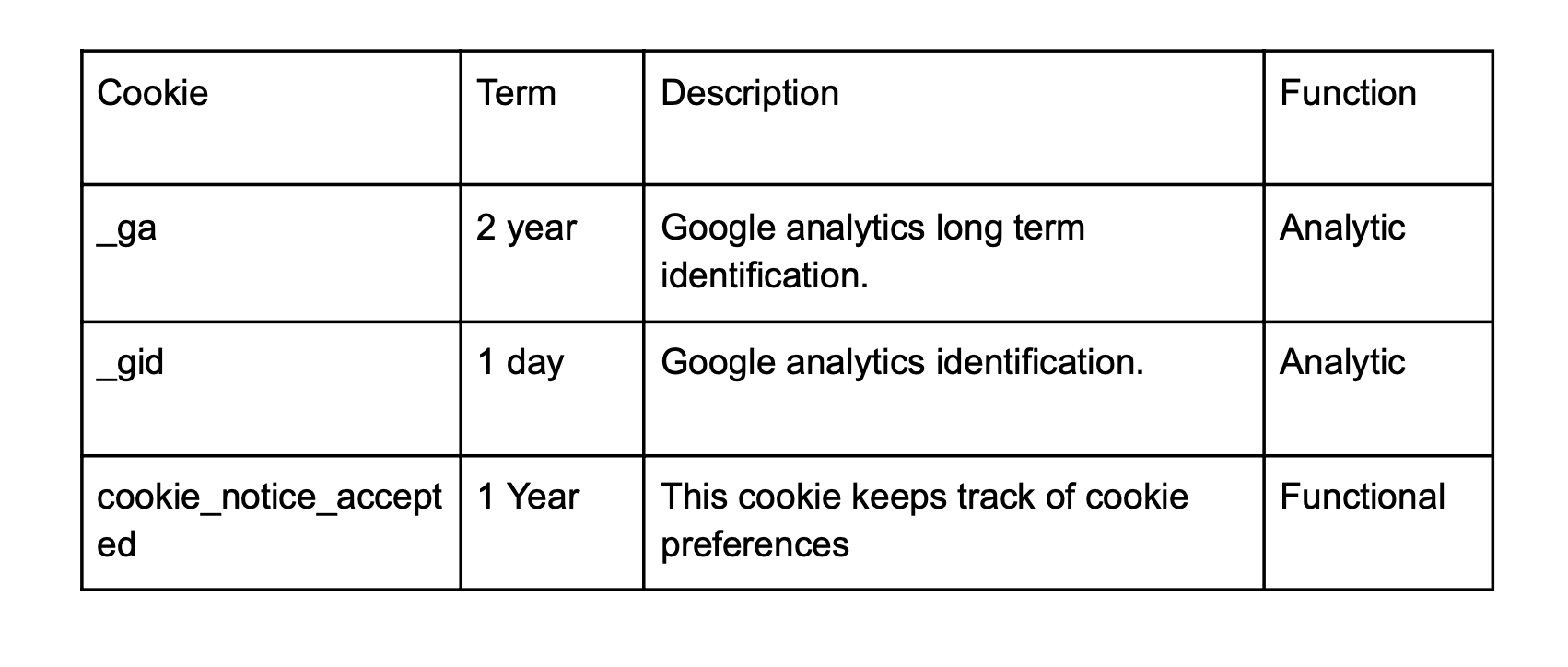
Get into more uses cookies for functional and analytical purposes. Cookies are small, locally stored, files that websites use to track information about users. For more information about cookies, please visit: https://cookiesandyou.com.
The main purpose of cookies placed by our website is to track user experience throughout the website. We save data about how users navigate the website, but are strict to never collect personally identifiable data. This means we don’t collect data like exact locations, ip-addresses and keystrokes. We collect the minimum amount of data required for our purposes and will never sell any of it to third parties. We do not use cookies to retarget, remarket or identify users in any way.
To effectively and safely process data collected we work with one data-processors (Google). Google is restricted from processing data without explicit request and prohibited from becoming a controller and processing and sharing the data any further, outlined in our Data Processing Agreement.
Our partner in the web area, both in construction and data collection, is OWOW (https://owow.agency)an agency based in Eindhoven. We collaborate to build a data stream that collects and processes important data efficiently and safely for us.
In the table below, you can find an overview of the Cookies we use, their function and the period they are active.